Where do you start when choosing a tattoo style?
Start with the idea, never with the style. A portrait that matters, the memory of a garden, a silhouette to be read from a distance: it is the design that calls for its register, not the other way round. Three questions are enough to narrow the choice: which idea, which area of the body, which relationship with time.
The area, because the skin has its rules: fingers, palms and soles hold a fine line poorly, and Sophie will suggest another placement or another register instead. Time, because every style ages in its own way: a solid blackwork fill comes through the years because there is nothing fine to watch disappear, while a fine line softens without fading away. That ageing is planned into the drawing, not endured.
Which tattoo styles are practised at the studio?
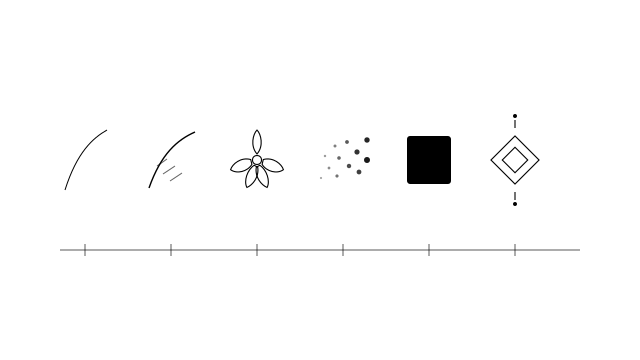
Six, all in black ink: fine line, sketch, floral, black & grey, blackwork and dark ornamental. Each register has its own page, its healed examples and its honest limits; here is the ridgeline between them.
- Fine line: lines drawn in a single breath, fine as a pen stroke, for precise, understated pieces.
- Sketch: the lively line of the sketchbook laid on the skin just as it is, visible hatching, nothing smoothed over.
- Floral: botanicals in black ink, flowers and foliage composed to follow the area that carries them.
- Black & grey: black diluted into grey washes, from the lightest to the deepest, for volume and relief.
- Blackwork: bold, graphic areas of solid black that rely on contrast and mass rather than detail.
- Dark ornamental: lace in ink, symmetries and repeated patterns that follow the anatomy, somewhere between jewellery and tattoo.
What is the difference between black & grey and blackwork?
Black & grey works with light, blackwork works with mass. The first thins black into successive washes to get a whole scale of greys: it is the style of volume and depth, the style of portraits, vanitas and drapery, where the shadow does everything. The second lays a solid, dense black with clean-cut shapes, and the design reads from a distance.
The confusion comes from the name, since both contain nothing but black. On the skin, though, the difference between black & grey and blackwork leaps out: relief and texture on one side, a bold contrast made to last for decades on the other. And when it comes to covering an old tattoo, solid black is often the answer.
Is fine line really fragile?
No: its reputation for fragility comes from pieces that were badly done. A line set at the right depth, on a suitable area, softens over the years without fading away. What ages a tattoo is not time anyway, it is the sun: an SPF 50 on the exposed piece keeps the blacks deep.
Two honest limits, though. A very small, very detailed design eventually closes up: the minimum size is decided together, before the needle. And some areas do not carry a fine line; better to find that out at the consultation than during healing.
Where does realistic work go at SpookySo?
Into black & grey: it is the studio’s most realistic register. Not photographic reproduction, but a realism of shadow and texture, where Sophie builds her values from light to dark to stay in control of the final contrast. A realistic tattoo, as the studio understands it, is drapery that falls just right, a vanitas with weight to it, a portrait where the light turns.
And it needs saying plainly: for pure photographic realism or manga, Sophie is not the artist to come to. Better an honest steer from the first message than a piece that would betray both the artist’s style and your expectations.
How is the choice settled at the consultation?
With a real conversation, before any drawing. The idea, the area and the relationship with time all go on the table, and nothing goes on the skin until the drawing is exactly right. That is where hesitations get resolved: torn between fine line and shading, floral marries the two in a single piece; a design that is too small finds its true size on a larger area.
Come with images that speak to you, even contradictory ones: they often say better than the name of a style what you are looking for. The rest, Sophie translates into a drawing, once only, for one person.