Where does fine line’s reputation for fragility come from?
From pieces that were badly done, almost always. Search for reviews of fine line tattoos and you will land on two stories that never meet: pieces still crisp after years, and lines gone blurry within two summers. Both exist. The difference is not the style, it is the way the line was set, and what it was put through afterwards.
It has to be said that fine line forgives nothing. Little shading, no heavy fill behind which to rescue a hesitant line: the drawing rests entirely on the accuracy of the line. An uneven depth, a tiny design packed with detail, and the piece closes up over the years. When that happens, it is not the style that failed, it is the execution.
What happens to a fine line over the years?
It softens, it does not disappear. The ink sits in the dermis and it does not stay frozen there: over time it diffuses slightly, and a crisp line gains a fraction of softness. This happens to every tattoo, from the pen stroke to the solid black fill; it simply shows earlier on a fine line than on a mass. The ageing of fine line is not an anomaly, it is the most visible version of a general rule.
The depth of the line decides almost everything else. Set too deep, the ink spreads under the skin: the line blurs from the moment it heals. Set too shallow, it fades fast. At the right depth, it stays where the hand put it and the line only rounds off gently over the years. That is the level Sophie looks for on every pass, with a slow hand, never forcing the needle.
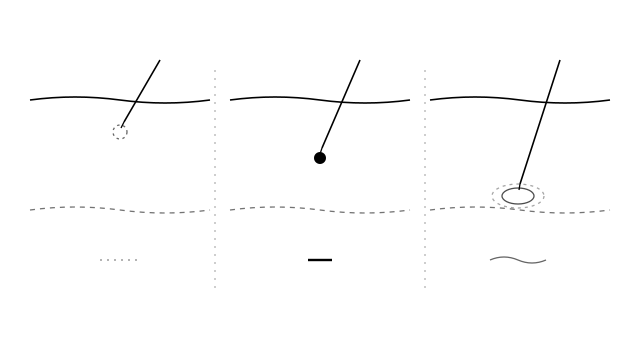
What makes a fine line tattoo last?
Three factors, and all three count. None of them makes up for the other two: the finest execution will not save a design set on a finger, and the best placement will not save a line pushed in too deep. A piece that ages well is a piece where these three conditions were met from the start, then held over time.
- The execution: Sophie works fine line with a 3RL needle, black ink only, with a slow hand and at a constant depth. A typical session runs from 1 h 30 to 3 h: a fine line is laid without rushing. It is the gesture that makes it last, well before the design.
- The placement: fingers, palms and soles hold a fine line poorly, the skin there works too much. If your project is aimed at one of these areas, Sophie suggests another area or another style, and explains why.
- Care and the sun: the four weeks of healing decide half the result, and the studio protocol details them step by step. After that, an SPF 50 on the exposed piece, for life. What ages a tattoo is not time, it is the sun.
What Sophie promises, and what she does not
She promises a line that softens without fading away. That evolution is planned into the drawing, never suffered: the spacing of the lines and the minimum size of the design are decided together at the consultation, so the piece stays readable in ten years, not just in the photo of the day. A touch-up can help once healing is complete; it is scheduled at the session, not in a rush.
She does not promise a frozen tattoo. A fine line lives with the skin that carries it, and claiming otherwise would be selling something other than tattooing. As for proof, it is not told, it is shown: the studio gallery presents healed work, dated, alongside the fresh piece of the day. Those are the pieces a fine line tattoo is really judged on.