A tattoo gone wrong: what can you actually do?
There are three answers, no more: the touch-up, which revives a tired piece without changing the design; the cover-up, which builds a new tattoo over the old one; the laser, which lightens or removes before rebuilding. Everything else is a sales pitch.
The right route doesn’t depend on how you feel about it today, but on the piece you’re wearing: its density, its age, its size, its placement. The piece decides, and the decision is made by looking at it, not by imagining it.
Touch-up or cover-up: how do you know?
It all comes down to one simple question: do you still like the design? If you do, but it has faded, the lines have softened more than planned or the blacks have lost their depth, a touch-up is enough. What has faded is revived, and the tattoo gets back the contrast of its early years.
If the design itself is the problem, no touch-up will change that: it has to be covered. A cover-up doesn’t correct a tattoo, it puts another one in its place, drawn so that the old piece disappears into the new.
- The touch-up: same design, contrast revived. It is planned on fully healed skin, never on a piece still doing its work.
- The cover-up: a new design, built from the old one. A bigger commitment and a longer job, but it’s a real piece, not a plaster.
What a cover-up can do
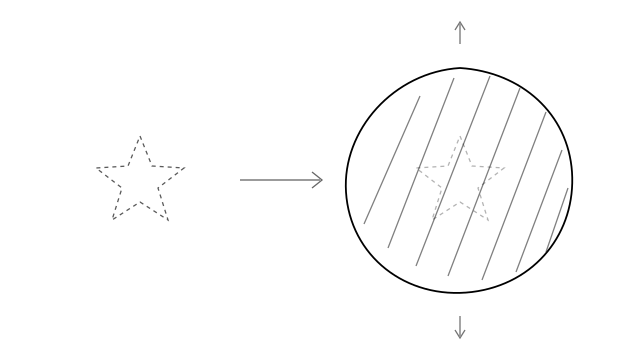
A successful tattoo cover-up obeys three physical rules, without exception. The new design will be larger than the old one, to enclose it and draw the eye away. It will be darker, because light ink doesn’t cover dark ink: on skin, dark always wins. And it’s the old tattoo that guides the new one: its masses become the shadows of the next design, its lines melt into the composition to come.
That is why the dark registers lend themselves to it naturally. Blackwork, with its solid fills of deep black, is often the answer: nothing shows through a dense, even mass. Black & grey offers another route: its gradients absorb the old piece into the shadows of the new, where volume makes you forget what sat underneath. The studio works exclusively in black, from the finest line to the densest fill: natural ground for a cover-up.
What a cover-up cannot do
Not everything can be covered as it is. A very dense, very dark or very large tattoo leaves little margin: the new design would have to be so black and so massive that it would no longer be a choice at all. Wanting a fine, airy piece over black that is already saturated isn’t a project, it’s a disappointment waiting to happen.
In those cases, a few sessions of preparatory laser change everything. The point isn’t to remove the old tattoo completely, but to lighten it enough to make the cover-up possible: the skin gets its margin back, the drawing gets its freedom back. That work is done by a specialised practitioner, ahead of the project.
How does it work at SpookySo?
It all starts with a sharp photo of the existing piece, sent through the contact form. Sophie assesses it on that basis and answers honestly: touch-up possible, cover-up worth considering, or laser first. Every cover-up is judged case by case, depending on the old tattoo; if the project isn’t realistic as it stands, she says so. Better a straight no than a cover-up that disappoints.
On pricing, these pieces count among the large pieces: covering a tattoo takes surface, black and time, often a full-day session. As with every project at the studio, you receive a written quote before the session, and nothing changes without talking it through. A multi-session piece moves to an overall quote, set at the consultation and then paid session by session. Once the date is set, the deposit is paid by bank transfer: a QR code and the IBAN are sent to you, nothing to pay when you send your request.